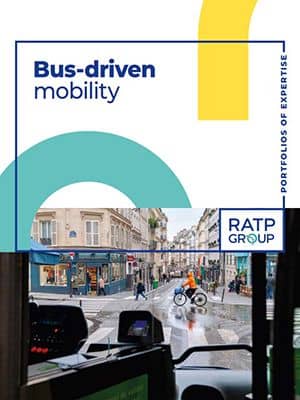
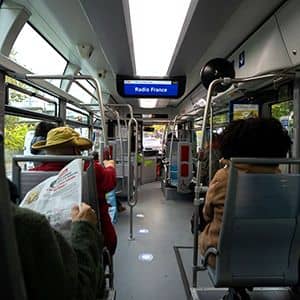
Buses, driving mobility
As an overground transport mode, buses continuously interact with cities’ ongoing activity, and with other users of public areas. Having acquired expertise in operating bus routes through dense urban environments, RATP Group relies on its specific on-the-ground knowledge to deploy bus service offerings across a wide range of regions, with a commitment to continuous improvement in service quality.
RATP Group has been the long-standing operator of the bus network in Paris and its inner suburbs. In this extremely dense urban environment, the Group has acquired unique experience and a foothold across the various links in the bus value chain.
Today, through its dedicated subsidiaries RATP Cap Île-de-France and RATP Dev, RATP Group deploys its integrated expertise to the benefit of the regions in which it operates. Be it in the Île-de-France region, in France, or abroad, the Group designs, operates, and transforms networks to rise up to the major environmental and societal challenges of the day. By partnering with transport authorities and local authorities, RATP Group bus divisions have developed custom sustainable, efficient, and affordable bus service offerings that can be scaled to residents’ requirements, in cities as diverse as Paris and Casablanca, and from Columbia (South Carolina) to Mantes-la-Jolie.
Urban and intercity buses, school buses, city centre shuttles, demand-responsive transport, and transport services for people with reduced mobility represent the wide variety of bus services that can fit every need, combining service quality and innovation to promote what is a truly flexible and agile transport mode.
RATP Group worldwide
billion journeys provided yearly
employees servicing bus operations
green buses (electricity, biomethane, and hydrogen)
Mobilising a community of experts for public benefit
Drivers, inspectors, traffic regulators, and maintenance operators make up the human dimension at the core of bus network operations. With an active role from the design phase to operations, RATP Group coordinates and integrates its renowned expertise in various fields, to increase the efficiency of networks of every size, and to provide a high-quality passenger experience.
Through training programmes, the Group invests heavily in developing and preserving these areas of expertise, with which it has stood out and led the industry. RATP bus teams are trained in-house at the NEF (nouvel espace formation, new training hub). This approach also applies to RATP Cap Île-de-France and RATP Dev, through their respective subsidiaries in France and abroad.
Over the course of their careers, teams continuously practice and perfect their driving skills in a dense urban environment, which is a guarantee of passenger safety, and a high level of service.
Our projects
Île-de-France region
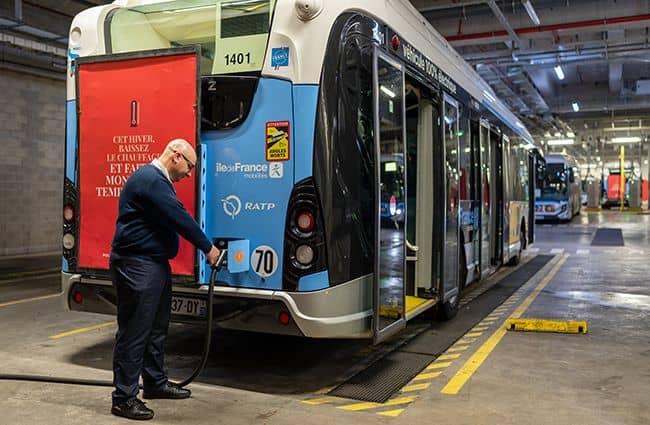
Through the Bus2025 programme, the Group has committed to a major technological and ecological development: the large-scale conversion of RATP-operated bus fleets to electricity and biomethane by 2025. Bus2025 is a joint commitment with Île-de-France Mobilités, with support from the European Commission and banking group Caisse des Dépôts et Consignation. To accommodate the vehicle fleet conversion, 25 bus depots were given a thorough makeover, without any disruptions to service.
The goal of this programme, which was launched in 2015, is to halve CO2 emissions generated by bus traffic.
Morocco
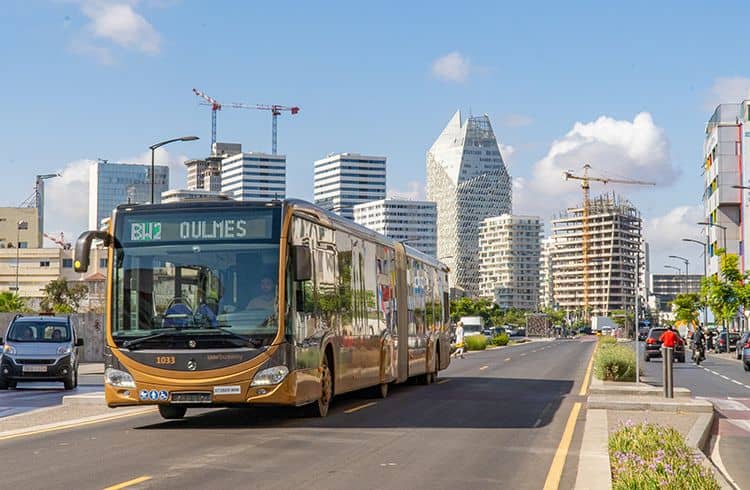
In Casablanca, RATP Dev Casablanca, which operates a tram network that extends over more than 70 kilometres, enhanced the interconnection of transport modes by launching two Casabusway rapid transit bus routes. Casabusway relieves traffic congestion while providing smoother journeys in the Moroccan financial capital.
What makes this project unique is that rapid transit buses, which have dedicated lanes and priority at traffic lights, guarantee regular and higher service frequency, while carrying a large number of passengers.
Italy
In November 2021, RATP Dev subsidiary Autolinee Toscane took over the concession for the region’s public transport networks. Autolinee Toscane operates 965 bus routes, with a 2,700-vehicle fleet covering a total distance of 110 million kilometres each year.
Its goal is to provide a simplified, comfortable, eco-friendly and innovative sustainable form of local transport that meets some of the highest service standards in Europe.
Ari%25C3%25A9-Botbol---bus---Florence---12.jpg&w=3840&q=70)
Did you know?
In October 2025, RATP Cap Île-de-France became the main operator of the bus network in Paris and the Île-de-France region. Île-de-France Mobilités chose to entrust more than 70% of operations to RATP Cap Île-de-France. This outcome rewards several years of work, team commitment, and meticulous preparation to deliver robust, competitive, and ambitious service offerings. As a result, 75% of the employees affected by the opening of the bus market to competition will remain within the RATP Group.
"“Efficiency, safety, passenger relations, and innovation are our trademarks. Our foothold in every aspect of bus operations enables us to develop custom bus service offerings that fit perfectly into the mobility ecosystems of today and tomorrow.”"
Patrice Lovisa
Director, Overground Networks Business Unit, RATP Group